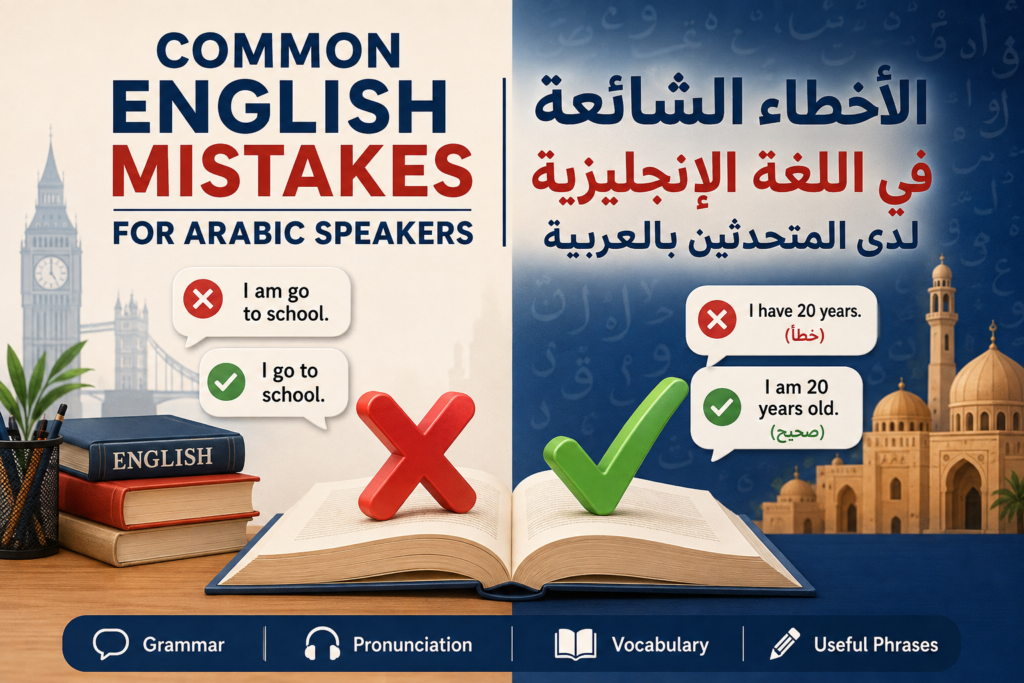
Common Article Mistakes (a/an/the) for Arabic Speakers | أخطاء أدوات التعريف والتنكير للعرب


Common Mistakes with Articles (a/an/the) for Arabic Speakers

الأخطاء الشائعة في استخدام أدوات التعريف والتنكير (a/an/the) للناطقين بالعربية


Introduction

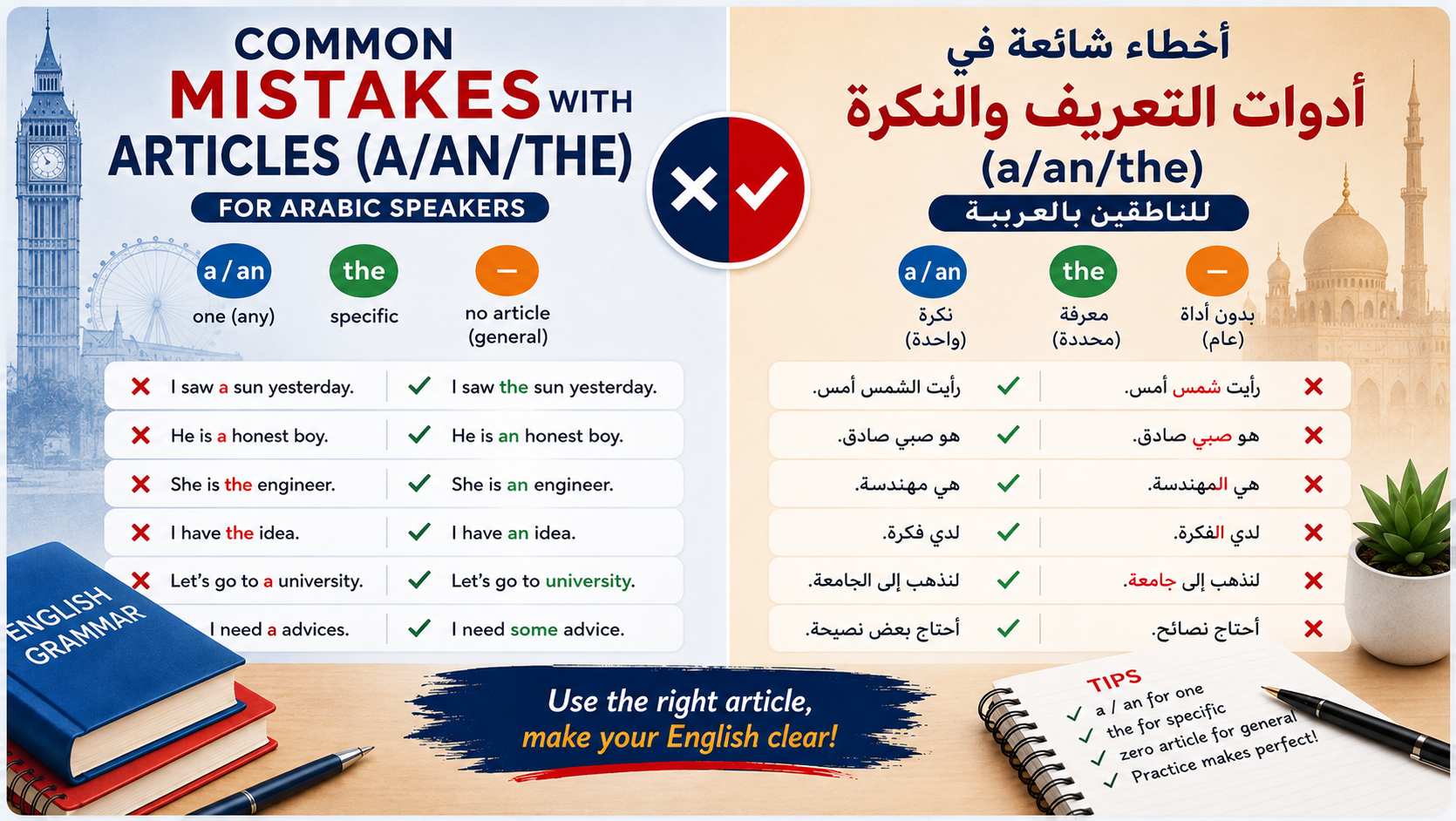
Articles are one of the most challenging areas of English for Arabic speakers. Arabic has only one definite article (الـ – al-), while English has three articles: a, an, and the. Additionally, English sometimes uses no article (zero article), which can be confusing.

This guide covers the most common article mistakes Arabic speakers make and provides practical tips to avoid them.

المقدمة

تُعد أدوات التعريف والتنكير من أكثر المجالات صعوبة في اللغة الإنجليزية للناطقين بالعربية. اللغة العربية لديها أداة تعريف واحدة فقط (الـ)، بينما الإنجليزية لديها ثلاث أدوات: a, an, and the. بالإضافة إلى ذلك، تستخدم الإنجليزية أحيانًا عدم وجود أداة، مما قد يكون مربكًا.

يغطي هذا الدليل الأخطاء الأكثر شيوعًا في استخدام أدوات التعريف والتنكير التي يقع فيها الناطقون بالعربية، ويقدم نصائح عملية لتجنبها.


1. Indefinite Articles: A vs AN

١. أدوات التنكير: A مقابل AN

The Mistake: Using “a” before vowel sounds or “an” before consonant sounds.

Examples:

  • I have a apple. → ✅ I have an apple.
  • She is an teacher. → ✅ She is a teacher.
  • It’s a hour later. → ✅ It’s an hour later.
  • He is an university student. → ✅ He is a university student.

Rules:

  • A → used before words that begin with a consonant sound
  • AN → used before words that begin with a vowel sound

Pronunciation-Based Rule (NOT spelling!):

SoundArticleExample
Consonant soundaa book, a cat, a dog, a university
Vowel soundanan apple, an hour, an umbrella

Tricky Cases (Focus on SOUND, not spelling!):

  • An hour → “h” is silent → vowel sound → use “an”
  • A university → “u” sounds like “you” → consonant sound → use “a”
  • An umbrella → “u” sounds like “uh” → vowel sound → use “an”
  • A European → “E” sounds like “you” → consonant sound → use “a”

Tip for Arabic speakers: Focus on the sound of the first letter, not the spelling. Does it sound like a vowel? Use “an”. Does it sound like a consonant? Use “a”.

الخطأ: استخدام “a” قبل الأصوات المتحركة أو “an” قبل الأصوات الساكنة.

أمثلة:

  • I have a apple. → ✅ I have an apple.
  • She is an teacher. → ✅ She is a teacher.
  • It’s a hour later. → ✅ It’s an hour later.
  • He is an university student. → ✅ He is a university student.

القواعد:

  • A → تُستخدم قبل الكلمات التي تبدأ بـ صوت ساكن
  • AN → تُستخدم قبل الكلمات التي تبدأ بـ صوت متحرك

قاعدة تعتمد على النطق (وليس الإملاء!):

الصوتالأداةمثال
صوت ساكنaa book, a cat, a dog, a university
صوت متحركanan apple, an hour, an umbrella

حالات صعبة (ركز على النطق، وليس الإملاء!):

  • An hour → “h” صامتة → صوت متحرك → استخدم “an”
  • A university → “u” تنطق “يو” → صوت ساكن → استخدم “a”
  • An umbrella → “u” تنطق “أه” → صوت متحرك → استخدم “an”
  • A European → “E” تنطق “يو” → صوت ساكن → استخدم “a”

نصيحة للناطقين بالعربية: ركز على صوت الحرف الأول، وليس على الإملاء. هل يبدو كصوت متحرك؟ استخدم “an”. هل يبدو كصوت ساكن؟ استخدم “a”.


2. Indefinite vs Definite Articles: A/AN vs THE

٢. أدوات التنكير مقابل أدوات التعريف: A/AN مقابل THE

The Mistake: Using “a/an” when “the” is needed, or using “the” when “a/an” is needed.

Examples:

  • I saw a Eiffel Tower. → ✅ I saw the Eiffel Tower.
  • She is the doctor. (first time mentioned) → ✅ She is a doctor.
  • Can you open a door? (specific door) → ✅ Can you open the door?
  • I want the apple. (any apple) → ✅ I want an apple.

Rules:

  • A/ANIndefinite (non-specific, one of many)
  • THEDefinite (specific, the listener knows which one)

When to use A/AN (Indefinite):

  • Mentioning something for the first time
  • Talking about something non-specific
  • Introducing a new topic
  • Talking about a profession

When to use THE (Definite):

  • Mentioning something again (already known)
  • Something specific or unique
  • When the listener knows which one
  • With superlatives (the best, the largest)

Example Story:

  • I saw a dog. The dog was big. (First mention → a, Second mention → the)
  • The sun is hot. (Unique → the)
  • She is a teacher. The teacher is kind. (Profession → a, Specific → the)

Tip for Arabic speakers: In Arabic, “الـ” is used for both specific and general. In English, use “a/an” for general and “the” for specific!

الخطأ: استخدام “a/an” عندما تكون “the” مطلوبة، أو استخدام “the” عندما تكون “a/an” مطلوبة.

أمثلة:

  • I saw a Eiffel Tower. → ✅ I saw the Eiffel Tower.
  • She is the doctor. (ذكر أول مرة) → ✅ She is a doctor.
  • Can you open a door? (باب محدد) → ✅ Can you open the door?
  • I want the apple. (أي تفاحة) → ✅ I want an apple.

القواعد:

  • A/ANتنكير (غير محدد، واحد من كثير)
  • THEتعريف (محدد، المستمع يعرف أيهما)

متى نستخدم A/AN (تنكير):

  • ذكر شيء لأول مرة
  • التحدث عن شيء غير محدد
  • تقديم موضوع جديد
  • التحدث عن مهنة

متى نستخدم THE (تعريف):

  • ذكر شيء مرة أخرى (معروف بالفعل)
  • شيء محدد أو فريد
  • عندما يعرف المستمع أيهما
  • مع صفات التفضيل (the best, the largest)

قصة مثال:

  • I saw a dog. The dog was big. (ذكر أول → a، ذكر ثاني → the)
  • The sun is hot. (فريد → the)
  • She is a teacher. The teacher is kind. (مهنة → a، محدد → the)

نصيحة للناطقين بالعربية: في العربية، تستخدم “الـ” لكل من المحدد والعام. في الإنجليزية، استخدم “a/an” للعام و”the” للمحدد!


3. No Article (Zero Article)

٣. عدم وجود أداة (Zero Article)

The Mistake: Adding an article when no article is needed.

Examples:

  • I go to the school every day. (general) → ✅ I go to school every day.
  • She speaks the English well. → ✅ She speaks English well.
  • I have the lunch at 1 PM. → ✅ I have lunch at 1 PM.
  • He goes to the work by car. → ✅ He goes to work by car.

When to use NO article (Zero Article):

CategoryExamples
Plural countable nouns (general)Dogs are friendly. (not The dogs are friendly)
Uncountable nouns (general)Water is essential. (not The water is essential)
LanguagesShe speaks Arabic. (not the Arabic)
School subjectsI study mathematics. (not the mathematics)
MealsI had breakfast. (not the breakfast)
Places (school, work, home)I go to school. (not the school)
SportsI play football. (not the football)
Days, months, seasonsI will come on Monday. (not the Monday)

Rule of Thumb:

  • Use NO article when talking about things in general.
  • Use THE when talking about specific things.

Tip for Arabic speakers: Arabic adds “الـ” to almost everything. In English, many general nouns do NOT need an article!

الخطأ: إضافة أداة تعريف عندما لا تكون مطلوبة.

أمثلة:

  • I go to the school every day. (عام) → ✅ I go to school every day.
  • She speaks the English well. → ✅ She speaks English well.
  • I have the lunch at 1 PM. → ✅ I have lunch at 1 PM.
  • He goes to the work by car. → ✅ He goes to work by car.

متى لا نستخدم أداة (Zero Article):

الفئةأمثلة
أسماء معدودة في الجمع (عامة)Dogs are friendly. (وليس The dogs are friendly)
أسماء غير معدودة (عامة)Water is essential. (وليس The water is essential)
اللغاتShe speaks Arabic. (وليس the Arabic)
المواد الدراسيةI study mathematics. (وليس the mathematics)
الوجباتI had breakfast. (وليس the breakfast)
الأماكن (school, work, home)I go to school. (وليس the school)
الرياضاتI play football. (وليس the football)
الأيام، الأشهر، الفصولI will come on Monday. (وليس the Monday)

قاعدة عامة:

  • لا تستخدم أداة عند التحدث عن الأشياء بشكل عام.
  • استخدم THE عند التحدث عن أشياء محددة.

نصيحة للناطقين بالعربية: تضيف العربية “الـ” إلى كل شيء تقريبًا. في الإنجليزية، العديد من الأسماء العامة لا تحتاج إلى أداة!


4. Countable vs Uncountable Nouns

٤. الأسماء المعدودة مقابل غير المعدودة

The Mistake: Using “a/an” with uncountable nouns or using plural forms incorrectly.

Examples:

  • I need an information. → ✅ I need some information.
  • She gave me an advice. → ✅ She gave me some advice.
  • I have a luggage. → ✅ I have some luggage.
  • I need a furniture. → ✅ I need some furniture.

Countable Nouns:

  • Can be counted (one, two, three)
  • Can be plural
  • Use a/an (singular) or the
  • Examples: book, chair, apple, student

Uncountable Nouns:

  • Cannot be counted
  • Usually singular
  • Use some or any (not a/an)
  • Examples: water, information, advice, furniture, luggage, news

Common Uncountable Nouns:

CategoryExamples
Liquidswater, milk, oil, tea, coffee
Foodbread, rice, pasta, cheese, meat
Abstractinformation, advice, knowledge, happiness, love
Mass nounsfurniture, luggage, equipment, homework
Materialswood, metal, glass, paper

Tip for Arabic speakers: Many nouns that are countable in Arabic are uncountable in English (information, advice, luggage, etc.). Don’t use “a/an” with them!

الخطأ: استخدام “a/an” مع الأسماء غير المعدودة أو استخدام صيغ الجمع بشكل غير صحيح.

أمثلة:

  • I need an information. → ✅ I need some information.
  • She gave me an advice. → ✅ She gave me some advice.
  • I have a luggage. → ✅ I have some luggage.
  • I need a furniture. → ✅ I need some furniture.

الأسماء المعدودة:

  • يمكن عدها (واحد، اثنان، ثلاثة)
  • يمكن جمعها
  • استخدم a/an (مفرد) أو the
  • أمثلة: book, chair, apple, student

الأسماء غير المعدودة:

  • لا يمكن عدها
  • عادةً مفردة
  • استخدم some أو any (وليس a/an)
  • أمثلة: water, information, advice, furniture, luggage, news

أسماء غير معدودة شائعة:

الفئةأمثلة
السوائلwater, milk, oil, tea, coffee
الطعامbread, rice, pasta, cheese, meat
مجردةinformation, advice, knowledge, happiness, love
أسماء كتليةfurniture, luggage, equipment, homework
الموادwood, metal, glass, paper

نصيحة للناطقين بالعربية: العديد من الأسماء المعدودة في العربية تكون غير معدودة في الإنجليزية (information, advice, luggage, إلخ). لا تستخدم “a/an” معها!


5. Articles with Proper Nouns

٥. أدوات التعريف مع الأسماء العلم

The Mistake: Using articles incorrectly with proper nouns.

Examples:

  • I visited the Dubai. → ✅ I visited Dubai.
  • She works at the Microsoft. → ✅ She works at Microsoft.
  • I read the Quran. → ✅ I read the Quran. (Correct!)
  • He is the Ahmed. → ✅ He is Ahmed.

Rules for Proper Nouns:

NO Article (Zero Article):

  • People’s names: Ahmed, Sarah, John
  • Countries (most): Egypt, Saudi Arabia, England
  • Cities: Dubai, London, Cairo
  • Companies (most): Microsoft, Apple, Google
  • Languages: Arabic, English, French
  • Universities (most): Harvard University, Cairo University

Always use THE:

  • Countries with “of”: the United States, the United Kingdom, the UAE
  • Oceans, seas, rivers: the Atlantic Ocean, the Red Sea, the Nile
  • Deserts, forests: the Sahara, the Amazon
  • Mountain ranges: the Alps, the Himalayas
  • Island groups: the Maldives, the Philippines
  • Newspapers: the New York Times, the Guardian
  • Holy books: the Quran, the Bible, the Torah
  • Hotels, museums: the Ritz, the Louvre

Tip for Arabic speakers: In Arabic, “الـ” comes before all proper nouns. In English, most proper nouns have NO article!

الخطأ: استخدام أدوات التعريف بشكل غير صحيح مع الأسماء العلم.

أمثلة:

  • I visited the Dubai. → ✅ I visited Dubai.
  • She works at the Microsoft. → ✅ She works at Microsoft.
  • I read the Quran. → ✅ I read the Quran. (صحيح!)
  • He is the Ahmed. → ✅ He is Ahmed.

قواعد الأسماء العلم:

بدون أداة (Zero Article):

  • أسماء الأشخاص: Ahmed, Sarah, John
  • الدول (معظمها): Egypt, Saudi Arabia, England
  • المدن: Dubai, London, Cairo
  • الشركات (معظمها): Microsoft, Apple, Google
  • اللغات: Arabic, English, French
  • الجامعات (معظمها): Harvard University, Cairo University

استخدم THE دائمًا:

  • الدول التي تحتوي على “of”: the United States, the United Kingdom, the UAE
  • المحيطات، البحار، الأنهار: the Atlantic Ocean, the Red Sea, the Nile
  • الصحاري، الغابات: the Sahara, the Amazon
  • سلاسل الجبال: the Alps, the Himalayas
  • مجموعات الجزر: the Maldives, the Philippines
  • الصحف: the New York Times, the Guardian
  • الكتب المقدسة: the Quran, the Bible, the Torah
  • الفنادق، المتاحف: the Ritz, the Louvre

نصيحة للناطقين بالعربية: في العربية، تأتي “الـ” قبل جميع الأسماء العلم. في الإنجليزية، معظم الأسماء العلم لا تحتوي على أداة!


6. Articles with Specific Expressions

٦. أدوات التعريف مع تعبيرات محددة

The Mistake: Using the wrong article in fixed expressions.

Common Errors:

  • I’m in the home. → ✅ I’m at home. (NO article)
  • She is in the hospital. (as a patient) → ✅ She is in hospital. (NO article) (British English)
  • I go to the school. (as a student) → ✅ I go to school. (NO article)
  • I need to go to the bed. → ✅ I need to go to bed. (NO article)
  • I have the flu. → ✅ I have the flu. (Correct!)

Expressions with NO article:

ExpressionExample
go to schoolI go to school every day.
go to universityShe goes to university.
go to workHe goes to work at 8 AM.
go homeI want to go home.
in hospitalHe is in hospital.
in prisonHe is in prison.
in bedShe is in bed.
at schoolI am at school.

Expressions with THE:

  • Diseases: the flu, the measles, the mumps
  • Musical instruments: the guitar, the piano, the violin
  • Entertainment: the cinema, the theatre, the movies
  • Superlatives: the best, the biggest, the most
  • Ordinals:
    Shopping Cart
    Scroll to Top