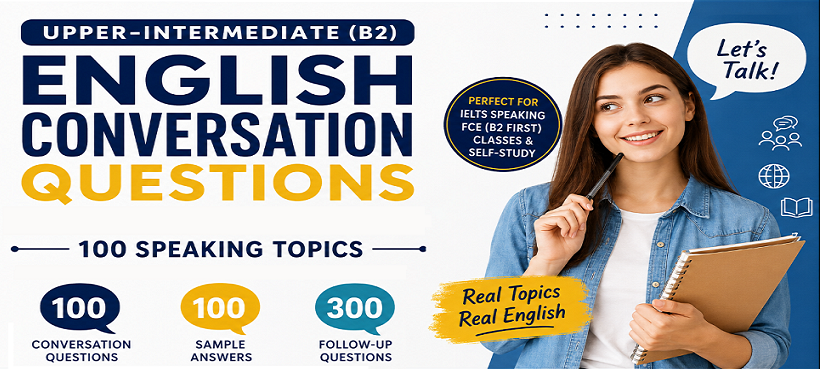
Looking for the best Upper-Intermediate English conversation questions? This comprehensive collection includes 100 engaging conversation questions designed for CEFR B2 learners, English teachers, tutors, and students who want to improve their speaking skills naturally and confidently.
Each conversation topic features real-life discussion questions, a model answer, and thought-provoking follow-up questions to help learners develop fluency, expand their vocabulary, and express their opinions using more advanced English.
Whether you’re preparing for the IELTS Speaking test, Cambridge B2 First (FCE), classroom discussions, speaking clubs, or online English lessons, these carefully designed questions provide meaningful opportunities to practice authentic communication.
What’s Included?
- ✅ 100 Upper-Intermediate (B2) English conversation questions
- ✅ 100 natural sample answers written at CEFR B2 level
- ✅ 300 follow-up questions to encourage deeper discussion
- ✅ 10 practical topics from everyday life
- ✅ Suitable for pair work, group discussions, speaking exams, and self-study
- ✅ Ideal for ESL and EFL classrooms
Conversation Topics
- Personal Growth
- Education
- Technology
- Work and Careers
- Travel
- Environment
- Health and Lifestyle
- Relationships
- Society
- Future
Who Is This Resource For?
This speaking resource is perfect for:
- English teachers looking for ready-to-use classroom activities
- ESL and EFL students at the Upper-Intermediate (B2) level
- IELTS and Cambridge B2 First (FCE) candidates
- Online tutors and conversation clubs
- Independent English learners who want to improve speaking confidence
Each question encourages learners to give extended answers, explain their opinions, provide reasons, share personal experiences, compare ideas, and practice advanced speaking skills in a natural way.
If you’re searching for Upper-Intermediate English speaking topics, B2 conversation questions, English discussion questions with answers, or conversation questions for ESL students, this collection is an excellent resource for building fluency, confidence, and communication skills.
English Conversation Questions for Upper-Intermediate (B2)
Topic 1: Personal Growth
1. What achievement are you most proud of?
Sample Answer:
I’m most proud of learning English well enough to communicate confidently with people from different countries. It wasn’t easy because it took years of consistent practice. Looking back, I realize that patience and determination were the keys to my progress. This achievement has also opened many new opportunities for me.
Follow-up Questions
- What difficulties did you face while achieving it?
- How did this achievement change your life?
- What’s another goal you’d like to accomplish?
2. How have you changed over the last five years?
Sample Answer:
I think I’ve become much more confident and independent. In the past, I often hesitated before making important decisions, but now I trust my judgment more. I’ve also learned how to manage my time better and focus on my long-term goals instead of worrying about small problems.
Follow-up Questions
- What caused these changes?
- Do you think people continue changing throughout their lives?
- What would you still like to improve about yourself?
3. What motivates you to work hard?
Sample Answer:
I believe personal growth is my biggest motivation. Every time I learn a new skill or accomplish a difficult task, I feel satisfied. I also enjoy setting goals because they give me something meaningful to work toward. Knowing that my efforts can improve my future keeps me motivated.
Follow-up Questions
- Do you prefer short-term or long-term goals?
- Who inspires you to work harder?
- Have you ever lost your motivation?
4. What’s the best piece of advice you’ve ever received?
Sample Answer:
The best advice I ever received was to never compare myself with other people. Everyone has different experiences and moves at their own pace. Since I started focusing on my own progress instead of comparing myself with others, I’ve become much happier and more productive.
Follow-up Questions
- Who gave you that advice?
- Have you ever given useful advice to someone else?
- Why do people sometimes ignore good advice?
5. Do you think people learn more from success or failure?
Sample Answer:
I believe people usually learn more from failure. Success feels rewarding, but failure forces us to reflect on our mistakes and find better solutions. Although failing can be disappointing, it often helps us become stronger and more experienced in the long run.
Follow-up Questions
- Can failure increase confidence?
- What’s a mistake you’ve learned from?
- Should parents protect children from failure?
6. If you could develop one new skill instantly, what would it be?
Sample Answer:
I’d choose to become fluent in several foreign languages. Being able to communicate with people from different cultures would make traveling easier and create more career opportunities. It would also allow me to understand different ways of thinking.
Follow-up Questions
- Which language would you learn first?
- Why are language skills important today?
- Can technology replace language learning?
7. How do you usually deal with stress?
Sample Answer:
Whenever I feel stressed, I try to take a short break and organize my thoughts. Going for a walk or listening to music usually helps me relax. I also remind myself that most problems can be solved if I stay calm and focus on one step at a time.
Follow-up Questions
- What causes the most stress in your life?
- Do you think people are more stressed today than in the past?
- How can schools help students manage stress?
8. Do you enjoy stepping outside your comfort zone?
Sample Answer:
Yes, although it can feel uncomfortable at first. I think personal growth often happens when we try something unfamiliar. Whether it’s speaking English with native speakers or learning a new skill, challenging myself usually makes me more confident.
Follow-up Questions
- What’s something difficult you’ve recently tried?
- Why are some people afraid of change?
- How important is confidence?
9. What personal quality do you value most?
Sample Answer:
I admire honesty more than any other quality. Honest people are usually trustworthy, and it’s much easier to build strong relationships with them. Even when the truth is difficult to hear, I believe honesty creates respect in the long term.
Follow-up Questions
- Is honesty always the best policy?
- Can someone be too honest?
- Which quality do you dislike most?
10. What kind of person would you like to become in the future?
Sample Answer:
I’d like to become someone who continues learning throughout life and helps others whenever possible. I hope to build a successful career while maintaining a healthy work-life balance. More importantly, I want to be remembered as someone who treated people with kindness and respect.
Follow-up Questions
- What steps are you taking to achieve that?
- Who has influenced your future goals?
- How do you define success?
Topic 2: Education
11. Do you think university education should be free?
Sample Answer:
I think university education should be affordable, but I’m not sure it should be completely free for everyone. Governments have limited budgets, so they need to balance spending on education with other important services like healthcare. However, talented students from low-income families should definitely receive financial support so they can continue their education without worrying about money.
Follow-up Questions
- Should students pay for their own education?
- How could governments make higher education more accessible?
- Is a university degree still necessary today?
12. What’s the most valuable thing you’ve learned outside school?
Sample Answer:
One of the most valuable lessons I’ve learned outside school is how to solve real-life problems. In school, we often focus on academic knowledge, but daily life teaches us communication, responsibility, and decision-making. I’ve found that these practical skills are just as important as what we learn from textbooks, especially in the workplace.
Follow-up Questions
- Who taught you that lesson?
- Should schools teach more practical skills?
- What life skill do many young people lack?
13. Is online learning as effective as traditional classroom learning?
Sample Answer:
I think it depends on the student and the subject. Online learning offers flexibility and allows students to study at their own pace, which is a big advantage. However, classroom learning provides direct interaction with teachers and classmates, making it easier to ask questions and participate in discussions. Ideally, a combination of both methods would provide the best learning experience.
Follow-up Questions
- What are the biggest advantages of online learning?
- What problems can students face when studying online?
- Would you like to take an online university course?
14. Which school subject do you think is the most useful?
Sample Answer:
If I had to choose one subject, I’d say English is one of the most useful because it allows people to communicate internationally. It also gives students access to a huge amount of information, books, and online resources. Besides English, I think financial education should also be considered essential since everyone needs to manage money responsibly.
Follow-up Questions
- Which subject did you enjoy the most?
- Are there any subjects that should be removed from the curriculum?
- What subject do students usually find the most difficult?
15. How has technology changed education?
Sample Answer:
Technology has completely transformed education. Students can now access online courses, digital libraries, educational videos, and interactive learning platforms from almost anywhere. Teachers can also use multimedia presentations and educational apps to make lessons more engaging. On the other hand, technology can sometimes distract students if it’s not used responsibly.
Follow-up Questions
- Do students rely too much on technology?
- Can AI improve education?
- What educational technology do you use most often?
16. Should schools focus more on exams or practical skills?
Sample Answer:
I believe schools should place greater emphasis on practical skills. Exams are useful for measuring knowledge, but they don’t always show whether students can apply what they’ve learned in real-life situations. Skills like teamwork, communication, problem-solving, and critical thinking are becoming increasingly important in today’s world.
Follow-up Questions
- Are exams an accurate way to measure intelligence?
- What practical skills should every student learn?
- How could schools balance exams and practical learning?
17. What qualities make a great teacher?
Sample Answer:
A great teacher is knowledgeable, patient, and enthusiastic about helping students learn. They should be able to explain difficult ideas in simple ways and encourage students to ask questions without feeling embarrassed. I also think a good teacher inspires curiosity and makes learning enjoyable instead of simply preparing students for exams.
Follow-up Questions
- Who was your favorite teacher?
- Can technology replace teachers?
- How should teachers deal with unmotivated students?
18. Should students be allowed to use artificial intelligence for homework?
Sample Answer:
I think students should be allowed to use AI as a learning tool, but they shouldn’t rely on it to complete all their assignments. AI can help explain difficult concepts, provide examples, and improve writing. However, if students simply copy AI-generated answers, they won’t develop their own thinking or problem-solving abilities.
Follow-up Questions
- How can schools prevent students from misusing AI?
- What are the benefits of using AI in education?
- Do you think AI will change the role of teachers?
19. Is it more important to memorize information or understand it?
Sample Answer:
In my opinion, understanding information is much more important than memorizing it. Memorized facts are easy to forget, but when you truly understand a concept, you can apply it in different situations. Of course, some memorization is necessary, especially for vocabulary or formulas, but real learning comes from understanding.
Follow-up Questions
- Which subjects require more memorization?
- Why do many students memorize instead of understanding?
- How do you remember new information?
20. If you could change one thing about the education system, what would it be?
Sample Answer:
I would make education more focused on real-life skills. Many students graduate without learning how to manage money, communicate effectively, or prepare for job interviews. Schools should spend more time teaching skills that students will actually use in their everyday lives and future careers.
Follow-up Questions
- Should students choose more of their own subjects?
- What changes would improve schools the most?
- Do you think education will be very different in the future?
Topic 3: Technology
21. How has technology changed the way people communicate?
Sample Answer:
Technology has completely transformed the way people communicate. Thanks to smartphones and social media, we can stay in touch with friends and family no matter where they live. Video calls, instant messaging, and email have made communication much faster and more convenient. However, I think people sometimes rely too much on digital communication and spend less time having meaningful face-to-face conversations. Finding a balance between online and offline communication is important.
Follow-up Questions
- Do you prefer texting or talking on the phone?
- Has social media improved communication or made it worse?
- How do you think communication will change in the future?
22. Could you imagine living without a smartphone?
Sample Answer:
It would definitely be difficult because I use my smartphone for many daily tasks, such as checking emails, navigating with maps, reading the news, and communicating with friends. However, I think living without one might also have some benefits. I’d probably spend less time on social media and become more focused on my surroundings. Although smartphones are incredibly useful, it’s important not to become too dependent on them.
Follow-up Questions
- Which app do you use the most?
- How many hours do you spend on your phone each day?
- Should people occasionally take a break from technology?
23. What are the advantages and disadvantages of artificial intelligence?
Sample Answer:
Artificial intelligence has many advantages. It can complete repetitive tasks quickly, improve healthcare, support education, and increase productivity in many industries. However, AI also raises concerns about job losses, privacy, and misinformation. I believe AI should be developed responsibly so that it benefits society while minimizing potential risks.
Follow-up Questions
- Which jobs are most likely to be replaced by AI?
- How do you use AI in your daily life?
- Should governments regulate AI development?
24. Do you think social media does more harm than good?
Sample Answer:
I think social media has both positive and negative effects. On one hand, it helps people connect, share ideas, and learn about current events. On the other hand, excessive use can lead to stress, misinformation, and unhealthy comparisons with others. In my opinion, social media is a useful tool as long as people use it responsibly and avoid spending too much time on it.
Follow-up Questions
- Which social media platform do you use most often?
- Should children be allowed to use social media?
- Have you ever taken a break from social media?
25. What invention has had the greatest impact on modern life?
Sample Answer:
I believe the internet is the most influential invention of modern times. It has changed the way we learn, work, shop, communicate, and entertain ourselves. Almost every aspect of daily life depends on internet access today. Although it has created some challenges, such as cybersecurity risks and misinformation, its overall impact has been overwhelmingly positive.
Follow-up Questions
- Could society function without the internet?
- What invention do you think is underrated?
- Which invention would you like to see in the future?
26. Should schools allow students to use smartphones during lessons?
Sample Answer:
I think smartphones should be allowed only when they serve an educational purpose. They can help students research information, use educational apps, or participate in interactive activities. However, if students use them for social media or games during class, they can become a major distraction. Teachers should establish clear rules to ensure smartphones are used appropriately.
Follow-up Questions
- Did your school allow smartphones?
- How can teachers prevent distractions?
- Should tablets replace textbooks?
27. Are people becoming too dependent on technology?
Sample Answer:
Yes, I believe many people have become overly dependent on technology. We often rely on GPS instead of remembering directions, calculators instead of doing simple math, and search engines instead of memorizing information. While technology makes life easier, depending on it too much may reduce some important skills. That’s why I think people should continue developing their abilities instead of relying entirely on digital tools.
Follow-up Questions
- Which skills are people losing because of technology?
- Can technology make people lazy?
- How can people reduce their dependence on technology?
28. How important is online privacy?
Sample Answer:
Online privacy is becoming more important every year because we share so much personal information online. If companies or hackers gain access to this data, it can lead to identity theft or other serious problems. People should use strong passwords, enable two-factor authentication, and think carefully before sharing personal information on the internet.
Follow-up Questions
- Are you careful about what you share online?
- Should companies collect users’ personal data?
- How can people protect their online privacy?
29. Would you like to work in the technology industry?
Sample Answer:
I think working in the technology industry would be interesting because it’s constantly evolving and offers many opportunities for learning and innovation. People who work in technology often solve real-world problems and create products that improve everyday life. Although the industry can be demanding, it also offers exciting career prospects and competitive salaries.
Follow-up Questions
- Which technology job interests you most?
- What skills are necessary for technology careers?
- Do technology jobs pay too much or too little?
30. What technological advances do you expect in the next 20 years?
Sample Answer:
I expect significant progress in artificial intelligence, renewable energy, medicine, and transportation. Self-driving cars may become common, and AI assistants will probably become much more advanced. Medical technology could help treat diseases that are currently difficult to cure. Although it’s impossible to predict everything, I believe technology will continue to make our lives more convenient while creating new ethical and social challenges.
Follow-up Questions
- Which future technology excites you the most?
- Are you optimistic about technological progress?
- Could technology ever become dangerous for humanity?
Topic 4: Work and Careers
31. What qualities make someone a good leader?
Sample Answer:
I believe a good leader should be honest, responsible, and able to communicate clearly. A strong leader listens to other people’s opinions before making decisions and treats everyone with respect. They should also be confident enough to solve problems and motivate others during difficult times. In my opinion, leadership isn’t about giving orders—it’s’s about helping people work together toward a common goal.
Follow-up Questions
- Have you ever worked with a good leader?
- Can leadership skills be learned?
- Is it better to lead by example or by giving instructions?
32. Would you rather have a high-paying job or a job you truly enjoy?
Sample Answer:
Ideally, I would like to have both, but if I had to choose, I’d prefer a job that I genuinely enjoy. Spending eight or more hours every day doing something I dislike would eventually make me unhappy, even if the salary were excellent. Of course, money is important because everyone has financial responsibilities, but job satisfaction has a much greater impact on long-term happiness.
Follow-up Questions
- How important is salary when choosing a career?
- Would you accept a lower salary for better working conditions?
- What makes a job enjoyable?
33. What is your dream job, and why?
Sample Answer:
My dream job would be one that allows me to keep learning while helping other people. I enjoy solving problems, communicating with others, and developing new skills, so I’d like a career that combines those interests. I also hope to have a flexible schedule and opportunities to work with people from different countries and cultures.
Follow-up Questions
- What skills are needed for your dream job?
- Has your dream job changed over the years?
- Would you be willing to move abroad for your ideal career?
34. Do you think working from home is better than working in an office?
Sample Answer:
Both options have their advantages. Working from home saves time and money because people don’t have to commute, and it often provides greater flexibility. However, working in an office encourages teamwork, face-to-face communication, and stronger relationships with colleagues. Personally, I think a hybrid system that combines both options offers the best balance.
Follow-up Questions
- Have you ever worked or studied from home?
- Which jobs cannot be done remotely?
- How does remote work affect productivity?
35. How important is work-life balance?
Sample Answer:
I think work-life balance is extremely important because people need time to relax, spend time with family, and pursue personal interests. If someone focuses only on work, they may experience stress or burnout over time. Maintaining a healthy balance not only improves mental health but also increases productivity because well-rested employees usually perform better.
Follow-up Questions
- Why do some people work too much?
- How can employers improve work-life balance?
- Do younger people value work-life balance more than older generations?
36. Should employees be allowed to work a four-day week?
Sample Answer:
I think a four-day workweek could be beneficial if it’s implemented carefully. Research suggests that employees often become more productive when they have more time to rest. A shorter workweek could also improve mental health and reduce stress. However, some industries, such as healthcare and emergency services, would need different schedules to continue providing essential services.
Follow-up Questions
- Would you support longer working hours for four days?
- Which professions would benefit the most?
- Could a four-day week improve productivity?
37. What skills are becoming more important in today’s workplace?
Sample Answer:
In today’s workplace, communication, problem-solving, adaptability, and digital skills are becoming increasingly important. Since technology changes so quickly, employees need to be willing to learn throughout their careers. Teamwork and emotional intelligence are also valuable because many jobs require people to collaborate with colleagues from different backgrounds.
Follow-up Questions
- Which skill do you most want to improve?
- Are technical skills more important than soft skills?
- How can people continue learning after they start working?
38. Do you think people will change careers more often in the future?
Sample Answer:
Yes, I believe changing careers will become much more common. Technology is creating new industries while making some traditional jobs less necessary. As a result, many people will need to learn new skills and adapt throughout their working lives. Lifelong learning will probably become essential for staying competitive in the job market.
Follow-up Questions
- Would you be willing to change careers?
- Why do people leave stable jobs?
- How difficult is it to start a new career later in life?
39. Is it better to work for a large company or a small business?
Sample Answer:
Both have advantages. Large companies often provide higher salaries, better benefits, and more opportunities for promotion. On the other hand, small businesses usually offer a friendlier atmosphere and allow employees to take on a wider variety of responsibilities. Personally, I think the best choice depends on someone’s personality and career goals.
Follow-up Questions
- Which would you prefer?
- Do small businesses treat employees better?
- Where can people learn more skills?
40. If you could start your own business, what would it be?
Sample Answer:
If I had the opportunity, I’d like to start an education-related business, such as an online learning platform or a language training center. Education has the power to improve people’s lives, and technology makes it possible to reach learners from all over the world. Although running a business involves financial risks, I think helping people learn new skills would make the work both meaningful and rewarding.
Follow-up Questions
- What challenges do new businesses usually face?
- Would you rather be your own boss or work for someone else?
- What qualities are necessary to become a successful entrepreneur?
Topic 5: Travel
41. What is the most memorable trip you have ever taken?
Sample Answer:
The most memorable trip I’ve ever taken was to a historical city that I’d always wanted to visit. I was fascinated by the ancient buildings, museums, and local culture. One of the highlights was trying traditional food and talking to local people, who were very welcoming. The trip gave me a better understanding of the country’s history and made me appreciate how traveling can broaden a person’s perspective.
Follow-up Questions
- What made this trip so special?
- Would you like to visit the same place again?
- What did you learn from the experience?
42. Do you prefer traveling alone or with other people?
Sample Answer:
I usually prefer traveling with other people because sharing experiences makes a trip more enjoyable. It’s nice to have someone to talk to, take photos with, and solve problems together if something unexpected happens. However, traveling alone also has its advantages because it gives you complete freedom to decide where to go and what to do. I think the best choice depends on the purpose of the trip.
Follow-up Questions
- Have you ever traveled alone?
- Who is your favorite travel companion?
- What are the disadvantages of group travel?
43. What can people learn from traveling?
Sample Answer:
Traveling teaches people much more than they can learn from books. It helps them understand different cultures, traditions, and ways of life. It also develops important skills such as independence, adaptability, and problem-solving because travelers often face unfamiliar situations. In my opinion, traveling makes people more open-minded and respectful of cultural differences.
Follow-up Questions
- Can people learn about other cultures without traveling?
- Should children travel more often?
- What life skills does traveling develop?
44. Do you think tourism always benefits local communities?
Sample Answer:
Not always. Tourism can create jobs, support local businesses, and improve infrastructure, which benefits many communities. However, if there are too many tourists, it can also lead to pollution, overcrowding, and higher living costs for local residents. I believe sustainable tourism is the best solution because it allows people to enjoy traveling while protecting local cultures and the environment.
Follow-up Questions
- What problems can mass tourism cause?
- How can tourists behave more responsibly?
- Should governments limit the number of tourists?
45. If money were not a problem, where would you travel first?
Sample Answer:
If money weren’t an issue, I’d love to take a long trip around the world. I’d like to visit countries with completely different cultures, such as Japan, New Zealand, Iceland, and Peru. Instead of rushing from one place to another, I’d spend enough time in each destination to experience everyday life, meet local people, and learn about their traditions.
Follow-up Questions
- Which country interests you the most?
- How long would your ideal trip last?
- Would you prefer luxury travel or backpacking?
46. Is it better to plan every detail of a trip or be spontaneous?
Sample Answer:
I think a balance between planning and spontaneity works best. It’s important to book flights, accommodation, and major attractions in advance, especially during busy seasons. However, leaving some free time allows you to discover unexpected places and enjoy local recommendations. Some of my favorite travel experiences have happened when my plans changed unexpectedly.
Follow-up Questions
- Do you usually make travel plans early?
- Have your travel plans ever gone wrong?
- What things should every traveler plan in advance?
47. How has technology changed the way people travel?
Sample Answer:
Technology has made traveling much easier than it was in the past. People can now book flights and hotels online, use GPS for navigation, translate foreign languages instantly, and read reviews before visiting attractions. Mobile apps also help travelers manage their schedules and find local restaurants or transportation. As a result, traveling has become more convenient and accessible for many people.
Follow-up Questions
- Which travel app do you find most useful?
- Could you travel without using the internet?
- Has technology made travel less adventurous?
48. What responsibilities do tourists have when visiting another country?
Sample Answer:
I believe tourists should respect local customs, traditions, and laws wherever they travel. They should avoid damaging historical sites, reduce waste, and support local businesses whenever possible. Learning a few basic phrases in the local language can also show respect and make communication easier. Responsible tourism helps preserve both the environment and local cultures for future generations.
Follow-up Questions
- Have you ever experienced disrespectful tourists?
- Should tourists learn about local customs before traveling?
- How can tourism become more environmentally friendly?
49. Do you think air travel will become more environmentally friendly in the future?
Sample Answer:
Yes, I believe the aviation industry will gradually become more environmentally friendly. Many companies are investing in sustainable aviation fuel, electric aircraft, and more fuel-efficient engines. Although these technologies are still developing, they have the potential to reduce carbon emissions significantly. Governments and airlines will also need to work together to encourage greener forms of travel.
Follow-up Questions
- Should people fly less to protect the environment?
- What other forms of transportation are environmentally friendly?
- Would you pay more for an eco-friendly flight?
50. If you could recommend one place in your country to foreign visitors, where would it be?
Sample Answer:
I would recommend a place that represents both the natural beauty and cultural heritage of my country. It could be a historic city, a national park, or a region known for its traditional food and hospitality. Visitors would have the opportunity to learn about local history, enjoy beautiful scenery, and experience authentic culture instead of only visiting popular tourist attractions.
Follow-up Questions
- What activities can visitors do there?
- What time of year is best to visit?
- Why do you think foreign tourists would enjoy it?
Topic 6: Environment
51. What do you think is the biggest environmental problem facing the world today?
Sample Answer:
In my opinion, climate change is the most serious environmental problem we face today. Rising temperatures are causing more frequent heatwaves, floods, droughts, and wildfires in many parts of the world. These changes affect not only nature but also agriculture, public health, and the global economy. Although solving climate change requires international cooperation, individuals can also make a difference by reducing waste, saving energy, and making environmentally friendly choices.
Follow-up Questions
- How does climate change affect your country?
- What can ordinary people do to help?
- Do you think governments are doing enough?
52. Should governments do more to protect the environment?
Sample Answer:
Yes, I believe governments should take stronger action to protect the environment. They can introduce stricter environmental laws, invest in renewable energy, improve public transportation, and encourage recycling. While individuals have responsibilities, governments have the resources and authority to create large-scale changes that can significantly reduce pollution and protect natural resources.
Follow-up Questions
- What environmental law would you introduce?
- Should companies receive fines for pollution?
- Is international cooperation necessary?
53. How important is recycling?
Sample Answer:
Recycling is very important because it helps reduce waste and conserves natural resources. By recycling materials like paper, plastic, glass, and metal, we can decrease the amount of garbage sent to landfills and reduce the need to produce new raw materials. However, recycling alone isn’t enough. People should also focus on reducing unnecessary consumption and reusing products whenever possible.
Follow-up Questions
- Do you recycle at home?
- Why do some people refuse to recycle?
- What materials are easiest to recycle?
54. Do you think electric cars are the future?
Sample Answer:
I think electric cars will become much more common in the future because they produce fewer emissions than traditional gasoline-powered vehicles. As battery technology improves and charging stations become more widely available, electric vehicles will probably become more affordable and practical. However, governments also need to ensure that the electricity used to charge these cars comes from clean energy sources.
Follow-up Questions
- Would you like to own an electric car?
- What are the disadvantages of electric vehicles?
- Should governments encourage people to buy them?
55. How can cities become more environmentally friendly?
Sample Answer:
Cities can become greener by expanding public transportation, creating more parks, planting trees, and encouraging cycling instead of driving. Improving recycling systems and using renewable energy in public buildings can also reduce pollution. In addition, city planners should design neighborhoods where people can easily walk to schools, shops, and workplaces instead of relying on cars.
Follow-up Questions
- Does your city have enough green spaces?
- How important is public transportation?
- Should city centers be closed to cars?
56. Should people change their lifestyle to protect the environment?
Sample Answer:
Yes, I think everyone should make small changes in their daily lives. For example, people can reduce plastic use, save water and electricity, avoid wasting food, and use public transportation more often. Although one person’s actions may seem insignificant, millions of people making similar choices can have a substantial positive impact on the environment.
Follow-up Questions
- Which environmentally friendly habit is easiest to adopt?
- What lifestyle changes have you made?
- Why do some people ignore environmental issues?
57. Is economic growth more important than environmental protection?
Sample Answer:
I don’t think we should see economic growth and environmental protection as opposing goals. A healthy economy depends on a healthy environment because natural resources are essential for many industries. Governments and businesses should focus on sustainable development, which allows economic progress while protecting the planet for future generations.
Follow-up Questions
- Can businesses be both profitable and environmentally responsible?
- Should environmental protection sometimes slow economic growth?
- What is sustainable development?
58. What environmental problem worries you the most personally?
Sample Answer:
The issue that worries me most is plastic pollution. Every year, millions of tons of plastic end up in rivers and oceans, harming wildlife and damaging ecosystems. Since plastic takes hundreds of years to break down, the problem continues to grow. I think governments, companies, and consumers all need to work together to reduce the use of single-use plastics.
Follow-up Questions
- Have you reduced your use of plastic?
- What alternatives to plastic do you use?
- Should plastic bags be completely banned?
59. Should companies be responsible for environmental damage?
Sample Answer:
Absolutely. Companies that pollute the environment should be held accountable for the damage they cause. They should invest in cleaner technologies, reduce waste, and follow environmental regulations. At the same time, consumers can encourage positive change by supporting businesses that use sustainable practices and avoiding those that harm the environment.
Follow-up Questions
- How can consumers influence companies?
- Should environmentally friendly companies pay lower taxes?
- How can governments monitor pollution?
60. Are you optimistic about the future of the environment?
Sample Answer:
I am cautiously optimistic. Although environmental problems are becoming more serious, public awareness has increased significantly over the past decade. More countries are investing in renewable energy, and many companies are developing cleaner technologies. If governments, businesses, and individuals continue working together, I believe we can make meaningful progress, even though the challenges are enormous.
Follow-up Questions
- What gives you hope for the future?
- Which country is a good example of environmental protection?
- What do you think the world will be like in 50 years if we don’t act now?
Topic 7: Health and Lifestyle
61. What does a healthy lifestyle mean to you?
Sample Answer:
To me, a healthy lifestyle is about maintaining a balance between physical and mental well-being. It involves eating nutritious food, exercising regularly, getting enough sleep, and managing stress effectively. I also believe that spending time with family and friends and having hobbies are important because good mental health is just as essential as physical fitness. A healthy lifestyle isn’t about being perfect; it’s about making consistent, positive choices every day.
Follow-up Questions
- What healthy habits do you practice regularly?
- Do you think it’s difficult to maintain a healthy lifestyle?
- How has your lifestyle changed over the years?
62. Why do many people find it difficult to stay healthy?
Sample Answer:
There are many reasons why people struggle to stay healthy. Busy work schedules often leave little time for exercise or preparing nutritious meals. In addition, unhealthy fast food is widely available and sometimes cheaper than healthier options. Stress can also lead people to develop poor habits, such as overeating or not getting enough sleep. I think improving health requires both personal commitment and supportive environments.
Follow-up Questions
- What unhealthy habits are becoming more common?
- How can governments encourage healthier lifestyles?
- Should schools teach more about nutrition?
63. How important is mental health?
Sample Answer:
Mental health is just as important as physical health because it affects how people think, feel, and interact with others. When someone has good mental health, they’re usually better able to handle stress, make decisions, and maintain healthy relationships. Unfortunately, many people still hesitate to talk about mental health because of social stigma. I think society should encourage open conversations and make professional support more accessible.
Follow-up Questions
- Why do some people avoid discussing mental health?
- How can people reduce stress in their daily lives?
- Should companies provide mental health support for employees?
64. Do you think people today exercise enough?
Sample Answer:
I don’t think most people exercise as much as they should. Many jobs require people to sit for long hours, and after work they often feel too tired to be physically active. Although more people are joining gyms or using fitness apps, a large number still lead sedentary lifestyles. Even simple activities like walking or cycling more often could make a significant difference.
Follow-up Questions
- What type of exercise do you enjoy most?
- Is walking enough to stay healthy?
- Why do some people lose motivation to exercise?
65. Should governments do more to reduce obesity?
Sample Answer:
Yes, I believe governments should take a more active role in reducing obesity. They can encourage healthier eating by providing nutrition education, supporting sports programs, and limiting the advertising of unhealthy food to children. They could also improve public spaces by building parks, walking paths, and cycling lanes so that people have more opportunities to stay active.
Follow-up Questions
- Should sugary drinks be taxed?
- How can schools help prevent obesity?
- Is obesity mainly a personal responsibility?
66. How has modern technology affected people’s health?
Sample Answer:
Modern technology has both positive and negative effects on health. On the positive side, medical technology has improved diagnosis and treatment, while fitness apps and smartwatches help people monitor their health. On the negative side, excessive screen time can contribute to poor posture, eye strain, sleep problems, and a lack of physical activity. Like many things, technology is most beneficial when it’s used in moderation.
Follow-up Questions
- Do you use any health or fitness apps?
- How much screen time is too much?
- Can technology encourage healthier habits?
67. What role does sleep play in maintaining good health?
Sample Answer:
Sleep plays a crucial role in both physical and mental health. During sleep, the body repairs itself, and the brain processes information and strengthens memories. People who don’t get enough sleep often struggle with concentration, mood, and productivity. That’s why I think getting seven to eight hours of quality sleep each night should be a priority rather than something people sacrifice for work or entertainment.
Follow-up Questions
- How many hours do you usually sleep?
- Why do many people stay up late?
- What helps you sleep better?
68. Is it possible to live a healthy life without giving up unhealthy food completely?
Sample Answer:
Yes, I think moderation is the key. People don’t need to avoid their favorite foods forever to stay healthy. Instead, they should eat nutritious meals most of the time while allowing themselves occasional treats. A balanced diet is more realistic and sustainable than following very strict diets, which many people eventually give up.
Follow-up Questions
- What unhealthy food do you enjoy most?
- Have you ever followed a special diet?
- Why do many diets fail?
69. Do you think people are living healthier lives than they did in the past?
Sample Answer:
It’s difficult to give a simple answer because there have been improvements as well as new challenges. On one hand, medical care, nutrition, and public awareness about health have improved significantly. On the other hand, many people now spend more time sitting, using computers, and eating processed food. Overall, I think people have better knowledge about health today, but not everyone puts that knowledge into practice.
Follow-up Questions
- What health problems are more common today?
- Were people more active in the past?
- How has modern life changed our habits?
70. If you could give one piece of health advice to everyone, what would it be?
Sample Answer:
I would encourage people to make small, consistent improvements instead of trying to change everything at once. Simple habits like walking every day, drinking more water, getting enough sleep, and reducing stress can have a significant impact over time. Many people look for quick solutions, but lasting health usually comes from maintaining good habits consistently rather than making drastic changes.
Follow-up Questions
- What healthy habit would you recommend to children?
- Why do people often ignore good health advice?
- What’s the hardest healthy habit to maintain?
Topic 8: Relationships
71. What qualities do you value most in a close friend?
Sample Answer:
The qualities I value most in a close friend are honesty, loyalty, and kindness. I believe a true friend is someone who supports you during both good and difficult times. They should also be someone you can trust and communicate with openly. Although people don’t always have to agree on everything, mutual respect and understanding are essential for maintaining a strong friendship over the years.
Follow-up Questions
- How do you usually make new friends?
- Can friendships last a lifetime?
- What can damage a friendship?
72. Do you think social media has changed friendships?
Sample Answer:
Yes, social media has changed friendships in many ways. It has become much easier to stay in touch with friends who live far away, and people can share important moments instantly. However, I also think social media sometimes creates more superficial relationships because online communication cannot completely replace spending time together in person. Real friendships still require trust, time, and meaningful conversations.
Follow-up Questions
- Do you keep in touch with old friends online?
- Can online friendships be as strong as face-to-face friendships?
- Has social media made people more or less social?
73. How important is honesty in a relationship?
Sample Answer:
I think honesty is one of the most important parts of any relationship. Without honesty, it’s very difficult to build trust, and trust is the foundation of healthy relationships. Of course, being honest doesn’t mean being rude. People should express the truth in a respectful and considerate way. Honest communication helps prevent misunderstandings and allows relationships to grow stronger over time.
Follow-up Questions
- Is it ever acceptable to tell a white lie?
- Can honesty sometimes hurt people’s feelings?
- How can people rebuild trust after it’s been broken?
74. What causes misunderstandings between people?
Sample Answer:
Misunderstandings often happen because people don’t communicate clearly or make assumptions about what others are thinking. Cultural differences, emotional stress, and poor listening skills can also lead to confusion. I believe many conflicts could be avoided if people took more time to explain themselves and listened carefully before reacting.
Follow-up Questions
- Have you ever experienced a serious misunderstanding?
- How do you usually resolve conflicts?
- Why is listening an important communication skill?
75. Do family relationships become stronger or weaker as people get older?
Sample Answer:
I think it depends on the family, but many relationships become stronger over time. As people grow older, they often appreciate their family more and understand the importance of spending time together. However, busy work schedules and living in different cities or countries can make it more difficult to maintain close relationships. Making time for regular communication is essential.
Follow-up Questions
- How often do you spend time with your family?
- What traditions bring families together?
- Is family more important than friends?
76. What makes a successful marriage or long-term relationship?
Sample Answer:
In my opinion, successful relationships are built on trust, communication, respect, and patience. Couples should be able to discuss problems openly instead of avoiding them. It’s also important to support each other’s goals and accept that nobody is perfect. Relationships require effort from both people, and small acts of kindness can make a big difference over time.
Follow-up Questions
- Is communication the most important factor?
- Why do some relationships fail?
- Should couples always have similar interests?
77. Is it easier or harder to make friends as an adult?
Sample Answer:
I think it’s generally harder to make friends as an adult because people become busier with work and family responsibilities. When we’re younger, we naturally meet new people at school or university every day. As adults, we usually have to make a conscious effort to join clubs, attend events, or participate in activities where we can meet others with similar interests.
Follow-up Questions
- Where can adults meet new people?
- Why do childhood friendships often last longer?
- Do you enjoy meeting new people?
78. How important is forgiveness in relationships?
Sample Answer:
Forgiveness is extremely important because no one is perfect, and everyone makes mistakes. Holding onto anger can damage relationships and create unnecessary stress. However, forgiveness doesn’t mean ignoring serious problems or accepting repeated bad behavior. I think people should forgive when someone sincerely apologizes and shows that they’re willing to change.
Follow-up Questions
- Is it easy for you to forgive others?
- Should people always apologize first?
- Can some mistakes never be forgiven?
79. Do you think people communicate better today than they did in the past?
Sample Answer:
In some ways, communication is easier because technology allows people to connect instantly from almost anywhere in the world. However, I don’t think communication is necessarily better. Many people spend more time sending short messages than having meaningful conversations. Face-to-face communication allows us to understand body language and emotions more clearly, which often leads to stronger relationships.
Follow-up Questions
- Do you prefer texting or talking in person?
- How has technology affected communication skills?
- What makes someone a good communicator?
80. What advice would you give someone who wants to build better relationships?
Sample Answer:
I would advise them to become a better listener. Many people focus on expressing their own opinions, but truly listening helps build trust and understanding. I’d also recommend being honest, showing appreciation, and making time for the people who matter. Strong relationships don’t happen automatically—they develop through consistent effort, mutual respect, and open communication.
Follow-up Questions
- What communication skill would you like to improve?
- How can people become better listeners?
- Why do some relationships gradually fade away?
Topic 9: Society
81. What do you think is the biggest challenge facing society today?
Sample Answer:
In my opinion, one of the biggest challenges facing society today is inequality. Although technology and economic development have improved many people’s lives, there are still significant differences in access to education, healthcare, and job opportunities. Reducing these inequalities requires cooperation between governments, businesses, and individuals. A fairer society benefits everyone because it creates greater stability and opportunities for future generations.
Follow-up Questions
- What causes inequality in society?
- Can education reduce social inequality?
- What role should governments play?
82. Do you think people are becoming more tolerant of different cultures?
Sample Answer:
I think people have become more open-minded in many parts of the world because international travel, the internet, and cultural exchange have increased. People now have more opportunities to learn about different traditions and perspectives. However, misunderstandings and prejudice still exist, so it’s important to continue promoting education, respect, and intercultural communication.
Follow-up Questions
- Why is cultural understanding important?
- Have you ever learned something interesting from another culture?
- How can schools encourage tolerance?
83. Should people do more volunteer work?
Sample Answer:
Yes, I believe volunteering is beneficial for both individuals and society. Volunteers help solve community problems while gaining valuable experience and developing new skills. Volunteering also encourages empathy and social responsibility because it allows people to understand the challenges others face. Even a few hours of volunteer work each month can make a meaningful difference.
Follow-up Questions
- Have you ever done volunteer work?
- Which organizations need volunteers the most?
- Should students be required to volunteer?
84. Do you think people today have a better quality of life than previous generations?
Sample Answer:
Overall, I think people enjoy a higher quality of life today because of advances in medicine, education, and technology. Life expectancy has increased, communication is easier, and people have access to more information than ever before. However, modern life also brings new challenges, such as stress, pollution, and the pressure to keep up with rapidly changing technology.
Follow-up Questions
- What aspects of life have improved the most?
- Are people happier today than in the past?
- What problems did previous generations not face?
85. How important is freedom of speech?
Sample Answer:
I believe freedom of speech is one of the foundations of a democratic society. It allows people to express their opinions, discuss important issues, and hold governments accountable. At the same time, freedom of speech comes with responsibility. People should express their views respectfully and avoid spreading false information or encouraging hatred and violence.
Follow-up Questions
- Should there be limits on freedom of speech?
- How can misinformation affect society?
- Why is respectful discussion important?
86. Do you think young people have enough influence in society?
Sample Answer:
I think young people have more influence today than ever before, mainly because of social media and easier access to information. Many young people actively participate in discussions about climate change, education, and social justice. However, I believe their opinions are sometimes underestimated because of their age. Society should encourage young people to participate in decision-making processes.
Follow-up Questions
- Should the voting age be lowered?
- How can young people create positive change?
- What issues are most important to young people today?
87. What responsibilities do citizens have?
Sample Answer:
Citizens have many responsibilities, including obeying the law, respecting others, paying taxes, and protecting public property. I also think people should stay informed about important social issues and participate in their communities whenever possible. Being a responsible citizen isn’t only about following rules; it’s also about contributing to the well-being of society.
Follow-up Questions
- Is voting an important responsibility?
- How can citizens improve their communities?
- Should everyone participate in community service?
88. How has the internet changed society?
Sample Answer:
The internet has transformed society by making information more accessible and communication much faster. People can now learn almost anything online, work remotely, and connect with others around the world. However, the internet has also created challenges such as misinformation, cybercrime, and online addiction. Like any powerful tool, its impact depends on how people choose to use it.
Follow-up Questions
- What would life be like without the internet?
- How can people identify reliable information online?
- Has the internet improved education?
89. What makes a community a good place to live?
Sample Answer:
A good community is one where people feel safe, respected, and supported. It should have good schools, healthcare, public transportation, and opportunities for recreation. Friendly neighbors and a strong sense of cooperation also make a community more enjoyable. When people trust one another and work together to solve problems, everyone benefits.
Follow-up Questions
- What do you like about your community?
- How can neighborhoods become safer?
- Is a strong community more important than a wealthy one?
90. If you could solve one social problem, what would it be?
Sample Answer:
If I could solve one social problem, I would choose poverty. Poverty affects many aspects of people’s lives, including education, health, housing, and employment opportunities. Reducing poverty would improve the quality of life for millions of people and create a more equal society. Although solving this issue is extremely difficult, investing in education and creating better job opportunities would be important first steps.
Follow-up Questions
- What is the main cause of poverty?
- How can education help reduce poverty?
- What role should governments and charities play?
Topic 10: Future
91. What do you think the world will be like in 2050?
Sample Answer:
I think the world in 2050 will be much more technologically advanced than it is today. Artificial intelligence will probably become part of everyday life, and many routine jobs may be automated. At the same time, I hope there will be significant progress in renewable energy and healthcare. Although technology will make life more convenient, people will also face new challenges related to privacy, employment, and environmental sustainability.
Follow-up Questions
- What technological changes do you expect?
- Do you think life will be easier or more difficult?
- What problems might future generations face?
92. Which job do you think will be the most important in the future?
Sample Answer:
I believe healthcare professionals and technology experts will become even more important in the future. As populations grow older and technology continues to develop, society will need skilled doctors, nurses, engineers, and AI specialists. Teachers will also remain essential because education will always play a key role in preparing people for new challenges.
Follow-up Questions
- Which jobs might disappear?
- What new careers do you expect to appear?
- Would you like to work in one of these fields?
93. Do you think artificial intelligence will improve people’s lives?
Sample Answer:
Overall, I think artificial intelligence has the potential to improve people’s lives in many ways. It can help doctors diagnose diseases more accurately, make transportation safer, and assist students in learning more effectively. However, AI also creates concerns about privacy, misinformation, and unemployment. To maximize its benefits, governments and companies should develop clear ethical guidelines for its use.
Follow-up Questions
- What is the greatest benefit of AI?
- What risks concern you the most?
- Should AI have limits?
94. Would you like to live on another planet if it became possible?
Sample Answer:
Although the idea sounds exciting, I don’t think I would choose to live permanently on another planet. Earth has everything we need, including diverse ecosystems, familiar cultures, and loved ones. However, I would definitely be interested in visiting another planet if space travel became safe and affordable. It would be an unforgettable experience to see Earth from space.
Follow-up Questions
- Which planet would you like to visit?
- Why are people interested in space exploration?
- Should governments spend more money on space programs?
95. What skill will be the most valuable in the future?
Sample Answer:
I think adaptability will become one of the most valuable skills because technology and society are changing so quickly. People who are willing to learn new skills and adjust to changing circumstances will have more opportunities throughout their careers. In addition, critical thinking and effective communication will remain essential, even as artificial intelligence becomes more advanced.
Follow-up Questions
- How can people become more adaptable?
- Which skills are becoming less important?
- Should schools focus more on lifelong learning?
96. How do you think education will change in the future?
Sample Answer:
I expect education to become much more personalized through the use of artificial intelligence and digital learning platforms. Students may receive lessons that are tailored to their individual strengths and weaknesses, allowing them to learn at their own pace. Although online learning will continue to grow, I believe teachers will remain important because they provide guidance, motivation, and emotional support that technology cannot fully replace.
Follow-up Questions
- Will classrooms still exist in the future?
- Can AI replace teachers completely?
- What subjects will become more important?
97. What invention would you most like to see in your lifetime?
Sample Answer:
I’d love to see a medical invention that can cure diseases that are currently incurable. Advances in medicine have already saved millions of lives, but there are still many illnesses that have no effective treatment. A breakthrough in this area would improve the quality of life for countless people and reduce suffering around the world.
Follow-up Questions
- Which medical invention has had the greatest impact?
- Should governments invest more in scientific research?
- What invention would make everyday life easier?
98. Are you optimistic about the future?
Sample Answer:
Yes, I’m generally optimistic about the future. Although the world faces many serious challenges, such as climate change and economic uncertainty, history shows that people are capable of finding creative solutions. Advances in science, technology, and international cooperation give me hope that future generations will enjoy better opportunities and a higher quality of life.
Follow-up Questions
- What gives you hope for the future?
- What worries you most about the future?
- Do you think young people are optimistic today?
99. If you could predict one thing about the future, what would it be?
Sample Answer:
If I could predict one thing, I would say that lifelong learning will become essential for everyone. Technology is changing so rapidly that people will probably need to update their skills several times throughout their careers. Those who continue learning and adapting will have more opportunities, while those who resist change may find it difficult to keep up.
Follow-up Questions
- What new skills would you like to learn?
- How often should people update their knowledge?
- Will universities become less important?
100. What advice would you give to your future self?
Sample Answer:
I would tell my future self to continue learning, stay curious, and never stop trying new things. I would also remind myself to spend more time with family and friends because success means very little without meaningful relationships. Finally, I’d encourage myself not to worry too much about things I can’t control and to appreciate the small moments that make life enjoyable.
Follow-up Questions
- What goals do you hope to achieve in the next ten years?
- What lessons would you like to remember?
- How do you define a successful life?