“`html
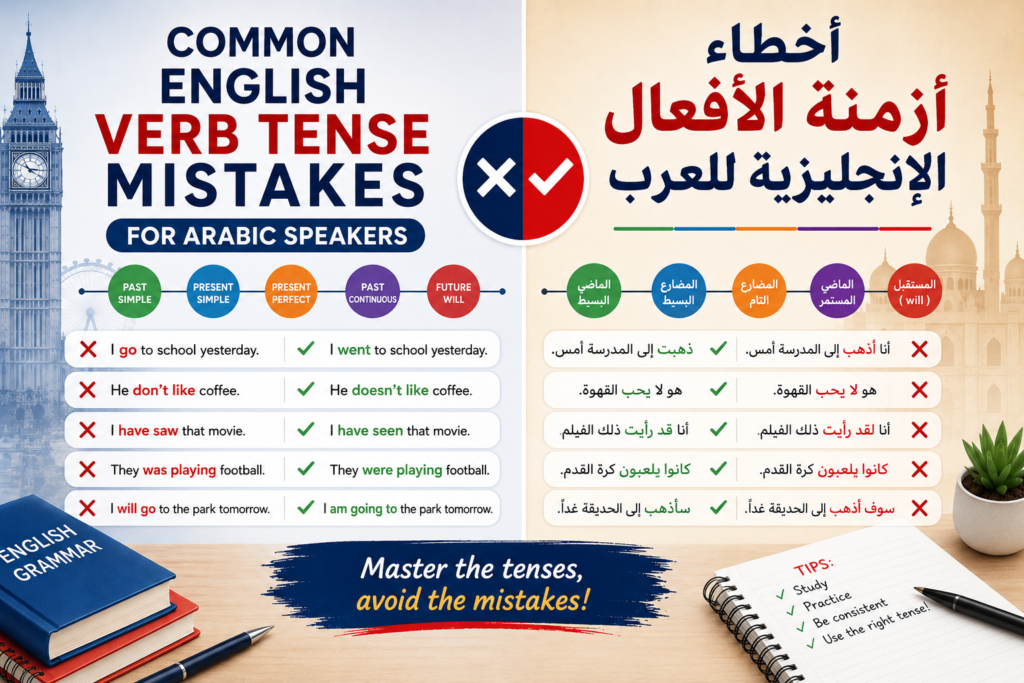
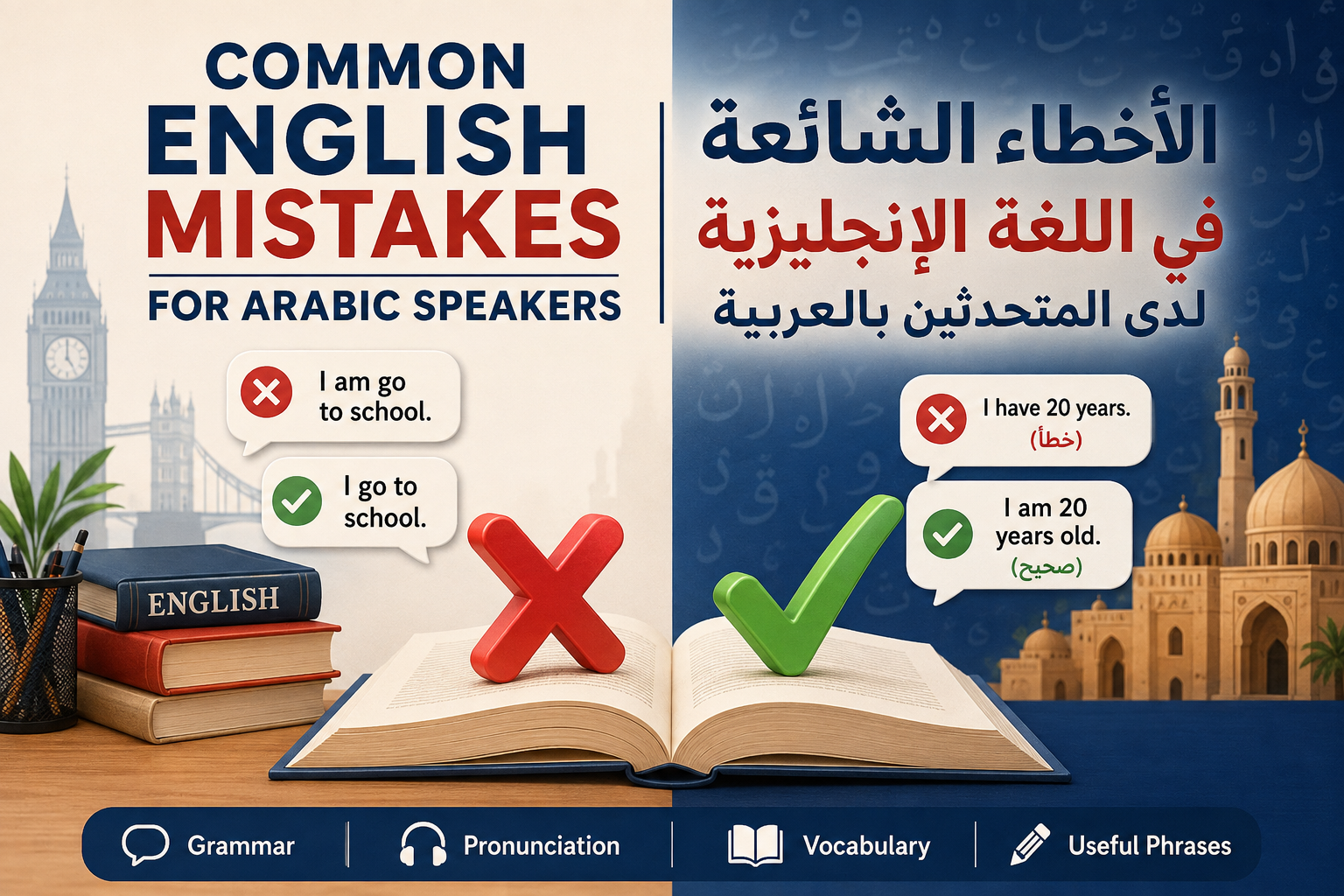
Common English Mistakes for Arabic Speakers
Learning English can be challenging for Arabic speakers because English and Arabic have different grammar, pronunciation, vocabulary, and sentence structures. Some mistakes are especially common among Arabic-speaking learners.
الأخطاء الشائعة في اللغة الإنجليزية لدى المتحدثين بالعربية
تعلُّم اللغة الإنجليزية قد يكون صعبًا للمتحدثين بالعربية، لأن اللغة الإنجليزية والعربية تختلفان في القواعد والنطق والمفردات وتركيب الجمل. وهناك بعض الأخطاء الشائعة بشكل خاص لدى متعلمي اللغة الإنجليزية من الناطقين بالعربية.
1. Using “is” with every sentence
Common mistake:
❌ I am go to school every day.
❌ She is work in a bank.
Correct:
✅ I go to school every day.
✅ She works in a bank.
In Arabic, learners may sometimes transfer sentence patterns directly into English. Remember that the present simple does not normally use am/is/are before the main verb.
1. استخدام “is” في كل جملة
الخطأ الشائع:
❌ I am go to school every day.
❌ She is work in a bank.
الصحيح:
✅ I go to school every day.
✅ She works in a bank.
في اللغة العربية، قد ينقل المتعلم أحيانًا تركيب الجملة العربية مباشرةً إلى الإنجليزية. تذكّر أن المضارع البسيط لا يحتاج عادةً إلى استخدام am/is/are قبل الفعل الرئيسي.
2. Forgetting the verb “to be”
Common mistake:
❌ I happy.
❌ She very tired.
❌ They students.
Correct:
✅ I am happy.
✅ She is very tired.
✅ They are students.
English requires a form of to be when the sentence has an adjective or noun as the complement.
2. نسيان فعل “to be”
الخطأ الشائع:
❌ I happy.
❌ She very tired.
❌ They students.
الصحيح:
✅ I am happy.
✅ She is very tired.
✅ They are students.
في اللغة الإنجليزية، نحتاج إلى استخدام أحد أشكال فعل to be عندما تحتوي الجملة على صفة أو اسم يأتي بعد الفاعل.
3. Confusing “he” and “she”
Common mistake:
❌ My sister is a doctor. He works at a hospital.
Correct:
✅ My sister is a doctor. She works at a hospital.
Arabic distinguishes between masculine and feminine nouns and pronouns, but learners may still accidentally use the wrong English pronoun, especially when speaking quickly.
He = هو
She = هي
3. الخلط بين “he” و”she”
الخطأ الشائع:
❌ My sister is a doctor. He works at a hospital.
الصحيح:
✅ My sister is a doctor. She works at a hospital.
يجب الانتباه إلى استخدام الضمائر الإنجليزية بشكل صحيح، خصوصًا عند التحدث بسرعة.
He = هو
She = هي
4. Confusing “do” and “make”
Arabic speakers often find it difficult to know when to use do and when to use make.
Examples:
✅ do homework
✅ do exercise
✅ do the housework
✅ make a mistake
✅ make a decision
✅ make a plan
Not:
❌ make homework
❌ do a mistake
4. الخلط بين “do” و”make”
قد يجد المتحدثون بالعربية صعوبة في معرفة متى نستخدم do ومتى نستخدم make.
أمثلة:
✅ do homework
✅ do exercise
✅ do the housework
✅ make a mistake
✅ make a decision
✅ make a plan
غير صحيح:
❌ make homework
❌ do a mistake
5. Using the wrong preposition
Prepositions are one of the most difficult areas for English learners because there is often no direct translation between English and Arabic.
For example:
❌ I am married with Ahmed.
✅ I am married to Ahmed.
❌ I arrived to the airport.
✅ I arrived at the airport.
❌ I am interested about English.
✅ I am interested in English.
Learning common expressions together with their prepositions can help.
5. استخدام حروف الجر بشكل غير صحيح
تُعد حروف الجر من أكثر الأمور صعوبة بالنسبة لمتعلمي اللغة الإنجليزية، لأنه لا توجد دائمًا ترجمة مباشرة لحرف الجر الإنجليزي في اللغة العربية.
على سبيل المثال:
❌ I am married with Ahmed.
✅ I am married to Ahmed.
❌ I arrived to the airport.
✅ I arrived at the airport.
❌ I am interested about English.
✅ I am interested in English.
من المفيد تعلُّم العبارات الشائعة مع حروف الجر التي تأتي معها بدلًا من حفظ حرف الجر وحده.
6. Saying “I have 20 years”
Arabic speakers may sometimes translate age expressions literally.
❌ I have 20 years.
✅ I am 20 years old.
or simply:
✅ I am 20.
In English, we use be, not have, to talk about age.
6. قول “I have 20 years”
قد يترجم بعض المتحدثين بالعربية التعبير عن العمر ترجمة حرفية.
❌ I have 20 years.
✅ I am 20 years old.
أو ببساطة:
✅ I am 20.
في اللغة الإنجليزية، نستخدم فعل to be وليس have للتحدث عن العمر.
7. Confusing “borrow” and “lend”
These two verbs are frequently confused.
Borrow = take something from someone temporarily
Lend = give something to someone temporarily
Examples:
✅ Can I borrow your pen?
✅ Can you lend me your pen?
❌ Can you borrow me your pen?
7. الخلط بين “borrow” و”lend”
غالبًا ما يحدث خلط بين هذين الفعلين.
Borrow = استعارة شيء من شخص لفترة مؤقتة
Lend = إقراض شيء لشخص لفترة مؤقتة
أمثلة:
✅ Can I borrow your pen?
هل يمكنني استعارة قلمك؟
✅ Can you lend me your pen?
هل يمكنك إقراضي قلمك؟
❌ Can you borrow me your pen?
8. Forgetting the “-s” with he, she, and it
In the present simple, the verb usually takes -s with he, she, and it.
❌ He work in a school.
✅ He works in a school.
❌ She speak English very well.
✅ She speaks English very well.
❌ My brother live in Dubai.
✅ My brother lives in Dubai.
8. نسيان إضافة “-s” مع he وshe وit
في المضارع البسيط، نضيف عادةً -s إلى الفعل مع he وshe وit.
❌ He work in a school.
✅ He works in a school.
❌ She speak English very well.
✅ She speaks English very well.
❌ My brother live in Dubai.
✅ My brother lives in Dubai.
9. Confusing “people” and “persons”
People is the normal plural of person in everyday English.
❌ There are many peoples in the room.
✅ There are many people in the room.
Also remember:
one person → two people
9. الخلط بين “people” و”persons”
كلمة people هي صيغة الجمع الأكثر شيوعًا لكلمة person في اللغة الإنجليزية اليومية.
❌ There are many peoples in the room.
✅ There are many people in the room.
تذكّر أيضًا:
one person → two people
10. Using “very” too much
Arabic-speaking learners sometimes use very frequently when speaking or writing.
Instead of always saying:
very good
very big
very small
very tired
You can sometimes use stronger vocabulary:
very good → excellent
very big → huge
very small → tiny
very tired → exhausted
This makes your English more natural and varied.
10. الإفراط في استخدام “very”
قد يفرط بعض المتحدثين بالعربية في استخدام كلمة very عند التحدث أو الكتابة باللغة الإنجليزية.
بدلًا من استخدام:
very good
very big
very small
very tired
يمكنك أحيانًا استخدام مفردات أقوى:
very good → excellent
very big → huge
very small → tiny
very tired → exhausted
يساعد استخدام مفردات أقوى وأكثر تنوعًا على جعل لغتك الإنجليزية أكثر طبيعية.
11. Pronouncing “p” like “b”
The /p/ sound can be difficult for some Arabic speakers because it does not exist in many varieties of Arabic.
Compare:
park /pɑːrk/
bark /bɑːrk/
pat
bat
Practice putting your lips together and releasing a small burst of air for /p/.
11. نطق “p” مثل “b”
قد يكون صوت /p/ صعبًا على بعض المتحدثين بالعربية لأنه غير موجود في العديد من اللهجات العربية.
قارن بين:
park /pɑːrk/
bark /bɑːrk/
pat
bat
تدرّب على ضم الشفتين ثم إطلاق الهواء عند نطق صوت /p/.
12. Pronouncing “th” incorrectly
English has two common th sounds:
/θ/ as in think
/ð/ as in this
Examples:
✅ think
✅ three
✅ thank
and:
✅ this
✅ that
✅ they
Learners may replace these sounds with /s/, /z/, /t/, or /d/.
12. نطق “th” بطريقة غير صحيحة
تحتوي اللغة الإنجليزية على صوتين شائعين لـ th:
/θ/ كما في think
/ð/ كما في this
أمثلة:
✅ think
✅ three
✅ thank
وكذلك:
✅ this
✅ that
✅ they
قد يستبدل المتعلمون هذه الأصوات بأصوات مثل /s/ أو /z/ أو /t/ أو /d/.
13. Confusing “fun” and “funny”
These words have different meanings.
Fun = enjoyable
Funny = making you laugh / humorous
✅ The party was fun.
✅ The movie was funny.
❌ The party was funny.
if you mean that you enjoyed it.
13. الخلط بين “fun” و”funny”
لهاتين الكلمتين معنيان مختلفان.
Fun = ممتع
Funny = مضحك / يثير الضحك
✅ The party was fun.
كانت الحفلة ممتعة.
✅ The movie was funny.
كان الفيلم مضحكًا.
❌ The party was funny.
إذا كنت تقصد أن الحفلة كانت ممتعة.
14. Using “actually” to mean “currently”
This is a common false friend.
Actually = in fact
Currently = now / at the present time
❌ Actually, I am working in Dubai.
if you mean “now.”
Better:
✅ Currently, I am working in Dubai.
But:
✅ Actually, I don’t live in Dubai.
= In fact, I don’t live in Dubai.
14. استخدام “actually” بمعنى “حاليًا”
هذا مثال شائع على الكلمات التي قد تسبب الخلط بسبب التشابه في المعنى.
Actually = في الواقع
Currently = حاليًا / في الوقت الحالي
❌ Actually, I am working in Dubai.
إذا كنت تقصد “الآن”.
الأفضل:
✅ Currently, I am working in Dubai.
لكن:
✅ Actually, I don’t live in Dubai.
= في الواقع، أنا لا أعيش في دبي.
15. Translating Arabic expressions word-for-word
One of the biggest challenges is translating Arabic expressions directly into English.
For example:
❌ Open the light.
✅ Turn on the light.
❌ Close the light.
✅ Turn off the light.
❌ I made a party.
✅ I had a party. / I threw a party.
❌ Give me a call on WhatsApp.
This may be understandable, but depending on the intended meaning, Call me on WhatsApp can be more natural.
The best way to avoid these mistakes is to learn English expressions as complete phrases, not word by word.
15. ترجمة التعبيرات العربية حرفيًا
من أكبر التحديات ترجمة التعبيرات العربية حرفيًا إلى اللغة الإنجليزية.
على سبيل المثال:
❌ Open the light.
✅ Turn on the light.
❌ Close the light.
✅ Turn off the light.
❌ I made a party.
✅ I had a party. / I threw a party.
❌ Give me a call on WhatsApp.
قد تكون هذه العبارة مفهومة، ولكن اعتمادًا على المعنى المقصود، قد تكون عبارة Call me on WhatsApp أكثر طبيعية.
أفضل طريقة لتجنب هذه الأخطاء هي تعلُّم التعبيرات الإنجليزية كعبارات كاملة بدلًا من ترجمة كل كلمة على حدة.
Quick Review
| Common Mistake | Correct English |
|---|---|
| ❌ I have 20 years. | ✅ I am 20 years old. |
| ❌ He work here. | ✅ He works here. |
| ❌ I am married with her. | ✅ I am married to her. |
| ❌ I made a mistake? | ✅ I made a mistake. |
| ❌ Can you borrow me a pen? | ✅ Can you lend me a pen? |
| ❌ She very tired. | ✅ She is very tired. |
| ❌ I am go to work. | ✅ I am going to work. |
| ❌ I am interested about it. | ✅ I am interested in it. |
| ❌ Open the light. | ✅ Turn on the light. |
| ❌ The party was funny. | ✅ The party was fun. |
مراجعة سريعة
| الخطأ الشائع | الإنجليزية الصحيحة |
|---|---|
| ❌ I have 20 years. | ✅ I am 20 years old. |
| ❌ He work here. | ✅ He works here. |
| ❌ I am married with her. | ✅ I am married to her. |
| ❌ I made a mistake? | ✅ I made a mistake. |
| ❌ Can you borrow me a pen? | ✅ Can you lend me a pen? |
| ❌ She very tired. | ✅ She is very tired. |
| ❌ I am go to work. | ✅ I am going to work. |
| ❌ I am interested about it. | ✅ I am interested in it. |
| ❌ Open the light. | ✅ Turn on the light. |
| ❌ The party was funny. | ✅ The party was fun. |
How Can Arabic Speakers Improve Their English?
Here are some practical tips:
1. Learn phrases, not individual words
Learn complete phrases instead of memorizing words separately.
2. Listen to native and fluent English speakers
Listen to English speakers regularly.
3. Practice pronunciation
Practice difficult sounds such as /p/, /v/, /θ/, and /ð/.
4. Avoid translating every sentence from Arabic
Try to think in English instead of translating every sentence from Arabic into English.
5. Keep a mistake notebook
Write down your common mistakes and record the correct sentence next to each one.
6. Practice speaking every day
Even 10–15 minutes of speaking every day can help you build confidence and fluency.
كيف يمكن للمتحدثين بالعربية تحسين لغتهم الإنجليزية؟
إليك بعض النصائح العملية:
1. تعلّم العبارات وليس الكلمات المنفردة
تعلم العبارات الكاملة بدلًا من حفظ الكلمات بشكل منفصل.
2. استمع إلى المتحدثين باللغة الإنجليزية
استمع إلى المتحدثين باللغة الإنجليزية بانتظام.
3. تدرّب على النطق
تدرّب على الأصوات الصعبة مثل /p/ و/v/ و/θ/ و/ð/.
4. تجنب ترجمة كل جملة من العربية
حاول التفكير باللغة الإنجليزية بدلًا من ترجمة كل جملة من العربية إلى الإنجليزية.
5. احتفظ بدفتر للأخطاء
اكتب أخطاءك المتكررة، ثم سجّل الجملة الصحيحة بجانب كل خطأ.
6. تدرّب على التحدث كل يوم
حتى 10–15 دقيقة من التحدث يوميًا يمكن أن تساعدك على بناء الثقة والطلاقة.
Final Tip
Making mistakes is a normal part of learning English. The goal is not to speak perfectly from the beginning. The goal is to notice your mistakes, understand why they happen, and practice the correct form.
With regular practice, Arabic-speaking learners can overcome these common difficulties and develop more natural, accurate, and confident English.
نصيحة أخيرة
ارتكاب الأخطاء جزء طبيعي من تعلم اللغة الإنجليزية. الهدف ليس التحدث بشكل مثالي منذ البداية، بل ملاحظة أخطائك وفهم سبب حدوثها والتدرب على الشكل الصحيح.
مع الممارسة المنتظمة، يستطيع المتعلمون الناطقون بالعربية التغلب على هذه الصعوبات الشائعة وتطوير لغة إنجليزية أكثر طبيعية ودقة وثقة.
“`